

In a previous blog, we introduced a simple neuroplasticity exercise designed to help you notice what happens in the body and mind during a reaction. The goal of that practice was awareness — because awareness is where emotional intelligence begins, and it’s the first real step in learning how to manage emotions.
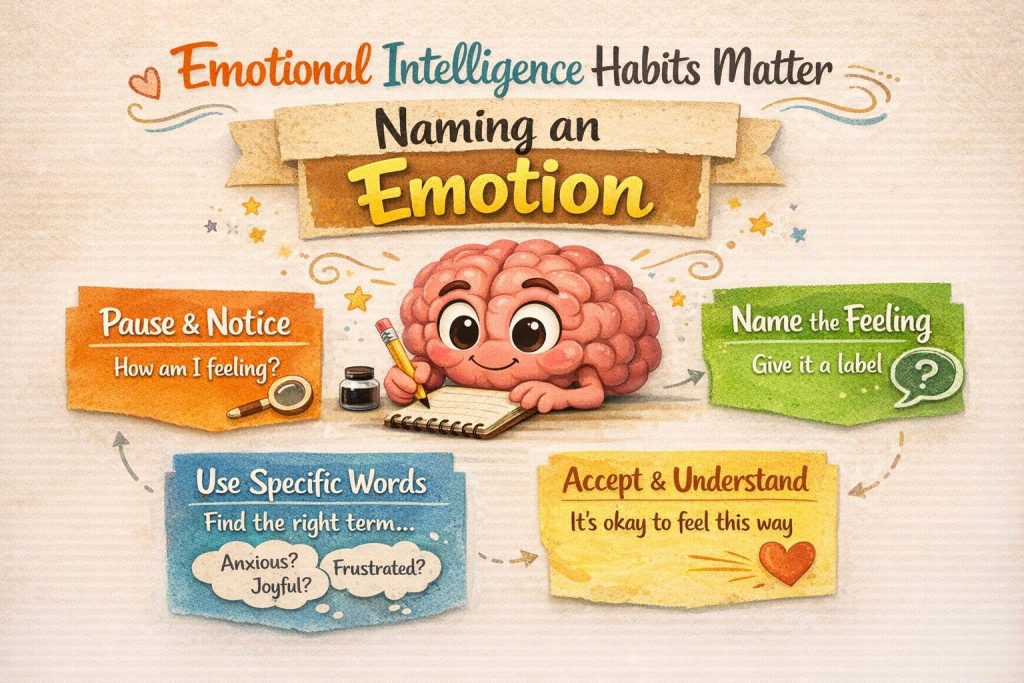
Once awareness of emotions and reactions is present, the next step in strengthening emotional intelligence habits is surprisingly simple: naming the emotion you’re experiencing in real time. It might sound almost too basic to matter, but both psychology and neuroscience point to the same conclusion. Identifying and labeling emotions plays a key role in emotional regulation — which is really just your ability to understand what you’re feeling and choose how to respond.
In other words, if you want to know how to manage emotions more effectively, it starts with this: awareness of what you feel + naming what you feel.
Emotional intelligence isn’t built through big, dramatic changes. It develops through small, repeatable habits like this — habits that help you understand your emotions, instead of being controlled by them.
Why Naming an Emotion Works (and How It Helps You Manage Emotions)
When an emotional response is active, the brain’s limbic system is engaged. This system processes emotional signals and reacts quickly to support safety and stability. And because it moves faster than the thinking parts of the brain, it often drives our initial reactions before we’ve had a chance to slow down and manage emotions more intentionally.
The challenge is that your brain is wired to keep you safe, so the limbic system tends to take over whenever something feels even slightly unsafe — real or not. When that happens, your thoughts can quickly become reactive, repetitive, or just plain unclear. This is where learning how to manage emotions becomes less of a theory and more of a real-life skill — and where something as simple as naming what you’re feeling can make a meaningful difference.
Psychologist Matthew Lieberman and colleagues at UCLA studied a process known as affect labeling, which refers to putting words to emotional experience. Their research found that when people labeled an emotion, activity in emotional centers of the brain decreased while areas related to emotional regulation became more active.
In simple terms, naming an emotion helps shift the brain from reaction toward regulation. When we simply acknowledge what is present in our experience, the nervous system can begin to sense safety and settle down.
“Name It to Tame It” — Why Regulation Comes Before Choice
You may have heard the phrase “name it to tame it,” often associated with psychiatrist Daniel Siegel’s work on emotional regulation. While the phrase is simple, it reflects something important about how the brain processes emotion, and how we begin to manage emotions more effectively.
When you accurately identify an emotion, you create a connection between what you feel and what you understand. That connection helps keep the thinking parts of the brain engaged, instead of leaving the emotional system to react on its own.
This doesn’t mean the emotion goes away. It means you become aware of it — and that awareness makes it easier to work with. That shift may feel subtle, but it matters.
Why does it matter?
When you can relate to and know an emotion instead of reacting to it, you set off a positive chain reaction.
- Awareness of emotion allows you to see its presence and consider its name.
- Naming an emotion creates opportunity for emotional regulation (lower emotional intensity) through connecting what you feel and what you understand.
- Emotional regulation creates opportunity for curiosity and reflection – e.g. asking, “what made what emotion pop up now?”
- Slowing down long enough to see an emotion, name it, and ask a question sets you up to consciously choose what happens instead of automatically reacting.
Why Naming Emotions Is Harder Than It Sounds
If naming emotions is so helpful, why do many people struggle with it?
One reason is that emotional dysregulation often shows up first as physical sensation rather than clear emotional language. You might notice tension, pressure, fatigue, or restlessness before you can identify what you’re feeling.
Another reason is simply lack of practice. Many people have not been taught to identify emotions with precision. Generalized words like “stressed,” “fine,” or “overwhelmed” often stand in for a more specific emotional experience.
There is also a practical reality. When emotions are intense, the nervous system is not always ready for reflection. Trying to analyze in those moments can feel frustrating or even overwhelming. Remember, emotions arise from the limbic system in response to a perceived lack of safety. If you are actually in danger and you pause to reflect, you may not react quickly enough to save yourself.
However, with constant notifications, updates, and streaming sources of near constant information – your limbic system is likely to be sending “check your safety” emotional signals when you are probably completely safe.
This is why the simple neuroplasticity exercise we introduced earlier focuses on awareness first.
If naming emotions feels difficult, returning to that basic awareness practice helps build the foundation you need to NOTICE emotions before you can name them.
You can revisit that exercise in our earlier blog on the simple neuroplasticity exercise to strengthen your emotional awareness and your first emotional intelligence habit.
Why Emotional Intelligence Habits Matter
The impact of emotional intelligence habits goes beyond awareness alone.
Across psychology and organizational research, emotional intelligence is consistently linked to better stress management, clearer communication, and more stable relationships, both personally and professionally. It also plays a direct role in decision-making. When you’re able to acknowledge and regulate emotions instead of ignoring or pushing them aside, your thinking becomes more balanced and less reactive, which is a key part of learning how to manage emotions in everyday situations.
At Move Strong Method®, we focus on emotional intelligence habits because they strengthen the connection between awareness, behavior, and choice – the cornerstone ABC method of our online coaching program. Without awareness, choices and behaviors tend to be reactive. With awareness and regulation, behavior becomes more intentional. And, intentional behavior is the fastest path to designing the life you most want to live every day.
The Role of Motivation: Knowing Your “Why”
Many people hesitate to practice emotional intelligence habits. Naming emotions can feel uncomfortable, unnecessary, or unfamiliar at first. That hesitation often comes from a natural tendency to avoid discomfort.
Naming an emotion requires a pause. It asks you to notice your internal experience instead of immediately moving into action. For people who are used to solving quickly or staying focused externally on other people or circumstances, that pause can feel unfamiliar.
This is where motivation becomes important.
Understanding why emotional intelligence matters to you makes the practice more relevant. You might want to communicate more clearly, reduce stress at work, or feel more steady during uncertainty or conflict. Identifying your why can help motivate you to try naming your emotions even if it causes you to face a little discomfort. When your “why” is clear, the habit of naming your emotions and managing your emotions becomes easier to practice.
Building Emotional Intelligence One Habit at a Time
Emotional intelligence habits do not develop through large changes. They develop through small habits repeated consistently.
- Noticing a body sensation before reacting.
- Recognizing when emotional pressure is rising.
- Naming an emotion when it becomes clear enough to identify.
Each of these small habits strengthens the connection between awareness (what you feel) and choice informed by what you understand. Over time, these small practices begin to shift how the brain operates which changes how you live each day. What once felt automatic becomes more intentional and what once felt overwhelming becomes more manageable.
This is how neuroplasticity works in everyday life. The brain adapts little by little every time you practice one of these small habits above.
A Final Thought
Emotional intelligence habits aren’t about controlling your emotions. They’re about building a working relationship with them — so you can respond with intention instead of reacting on autopilot. And when it comes to how to manage emotions, that shift is everything.
Naming an emotion might seem like a small step, but it creates a meaningful change in how your brain processes what you’re feeling. It slows things down just enough to give you space — and that space is where managing your emotion begins.
If naming emotions feels difficult right now, it doesn’t mean the skill is out of reach. It usually just means you need to return to the starting point: awareness. Learning to notice what’s happening in your body and mind is the foundation for everything that follows.
If you haven’t practiced that yet, it’s a great place to start before layering in this next step.
Over time, these small habits come together in a way that brings more calm, more clarity, and a stronger sense of control in how you show up each day.