
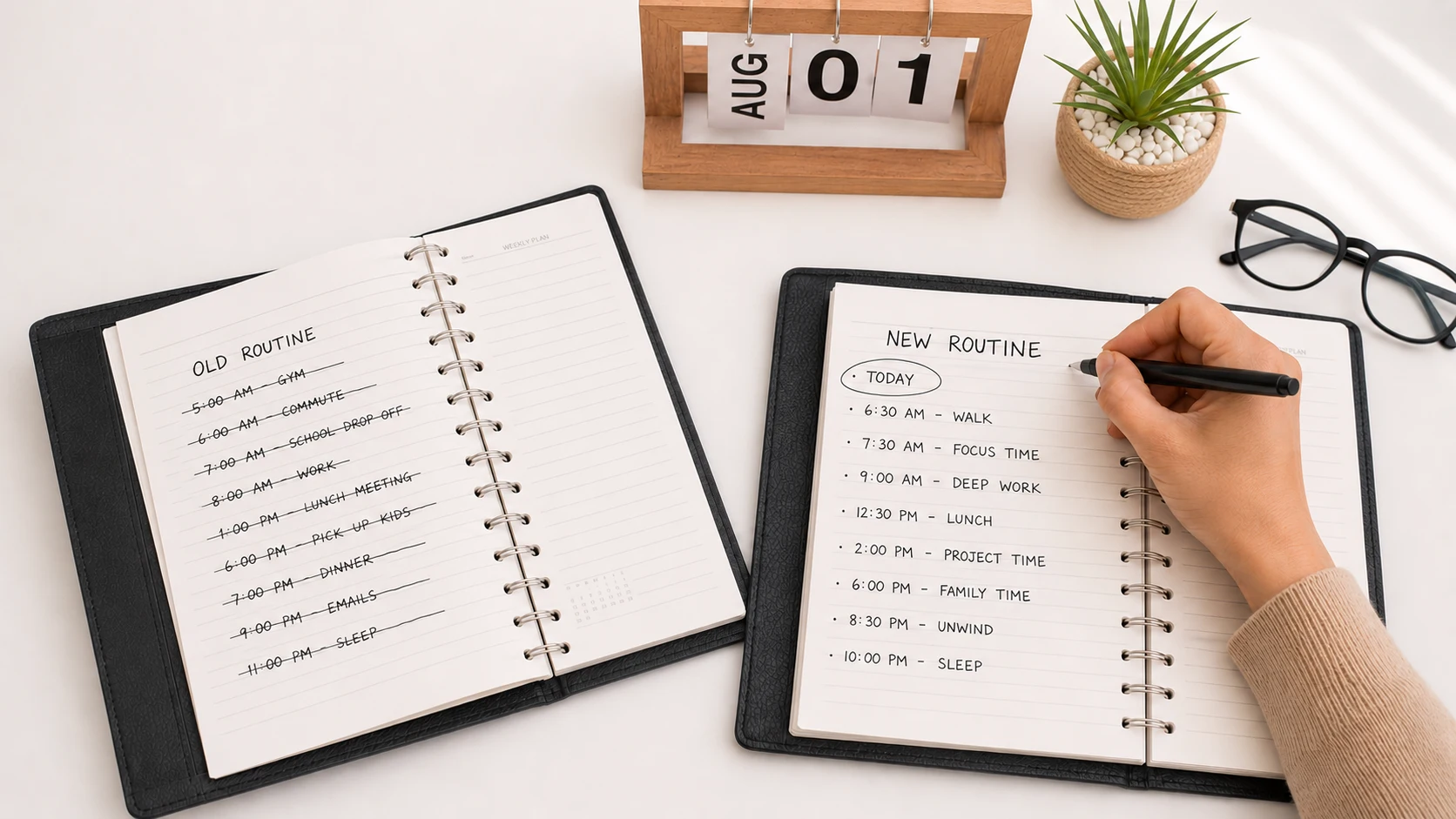
There’s something about August that makes us feel like we should be getting our lives ready for the end of summer and all that fall brings. Vacations are winding down. Kids head back to school. Work ramps up after a quieter summer. Calendars begin to fill…Suddenly, we tell ourselves, “I just need to get back into my routine.”
I hear this all the time in coaching. Someone will say, “Once I get back to my old routine, everything will be fine.”
I understand the feeling: It sounds logical. The problem is that it often creates unnecessary stress because we’re trying to return to a version of life that no longer exists.
One of the biggest concepts we teach through Move Strong Method® is this:
A change in circumstances requires a change in behavior.
Also known as, when life changes, your habits need to change with it. Trying to force yourself “back into an old routine” can leave you feeling frustrated, discouraged, and wondering why something that used to work suddenly feels so difficult.
When an old routine feels difficult, it’s rarely because of you. The routine simply no longer fits.
While it’s really important to take what’s worked before and use it again now, it is also very likely that what worked before needs to adapt to your current circumstances.
Why getting back into a routine sometimes feels impossible
If you’ve been trying to figure out how to get back into a routine, you’re probably looking for motivation or discipline.
In my experience, neither are the real issue. The real issue is that most people try to solve today’s problems with yesterday’s habits.
This is true with any life change. Sometimes it’s something big, like a new baby or a new job. Sometimes it’s as simple as the seasons changing.
When August hits, we can see and feel the need for something to change. The bottom line is that all change impact the demands placed on your brain and body.
When we feel this demand, we default to routines we know and expect old routines to continue working as if nothing has changed. It’s like using last year’s calendar to plan this year’s schedule. Some things will still fit, but many won’t because life has moved on.

A real life example
One Move Strong Method® client came to me after losing her mother. She wasn’t looking for grief counseling. She wanted help because she couldn’t concentrate at work anymore. Her mornings felt chaotic, she was forgetting simple tasks, and she found it increasingly difficult to focus clearly at work. Every evening, she promised herself that tomorrow would be different.
As we worked together, she saw that grief wasn’t just affecting her emotions. It had changed her daily life.
- Her energy was different.
- Her priorities were different.
- Her responsibilities were different.
Yet every morning she judged herself against the routine she had before her loss.
Once she stopped trying to recreate her previous schedule and started building a routine that reflected where she actually was, she experienced measurable improvements in every area of her life. Her old routine didn’t have space for grief, the everyday impact of that emotion, or the awareness required to name what she was feeling. Her new routine allowed her to be where she was and still find ways to move forward.
Instead of trying to “get back,” she started moving forward. That shift reduced the pressure she was putting on herself and made it much easier to live with the habits and experience she wanted to, alongside the loss of her mom.
What neuroscience tells us about routines
As a neuroscience-based coaching program, we spend a lot of time helping people understand what their brain is trying to accomplish outside of your conscious choice. Your brain loves efficiency and habits are one of its favorite tools because a habit reduces the amount of conscious decision-making required throughout the day.
But habits are built around context. Your morning routine isn’t just connected to the actions you perform. It’s connected to your environment, your schedule, your responsibilities, your energy, and even the emotions you’re carrying. When these conditions change, you need to adjust and update the action pattern you are trying to repeat.
To do this, you brain needs new information about what success looks like now – with the change in circumstance considered. Through repetition, you can begin creating new patterns and use simple neuroplasticity exercises to support the behaviors you want to strengthen. So, when your old routine suddenly feels impossible to stick to, don’t assume you’ve failed. It’s often a sign that you and your brain need to collaborate and create a routine that fits where your life is now.
Now what? What can we do to build new routines and habits that support them?
First things first—stop asking, “How do I get back?” Instead, ask yourself:
- What has changed since the last time this routine worked?
- What responsibilities do I have now?
- What do I need more of?
- What is most important now (compared to before)?
- What would make things feel a little easier?
These questions build awareness that will help you think of new actions and behaviors to support your current circumstances. At Move Strong Method®, we encourage a pause for building awareness and knowledge first before choice or action. Because, it’s difficult to choose a helpful habit or new behavior if you haven’t noticed what’s different now.
How to create a routine that fits your life today
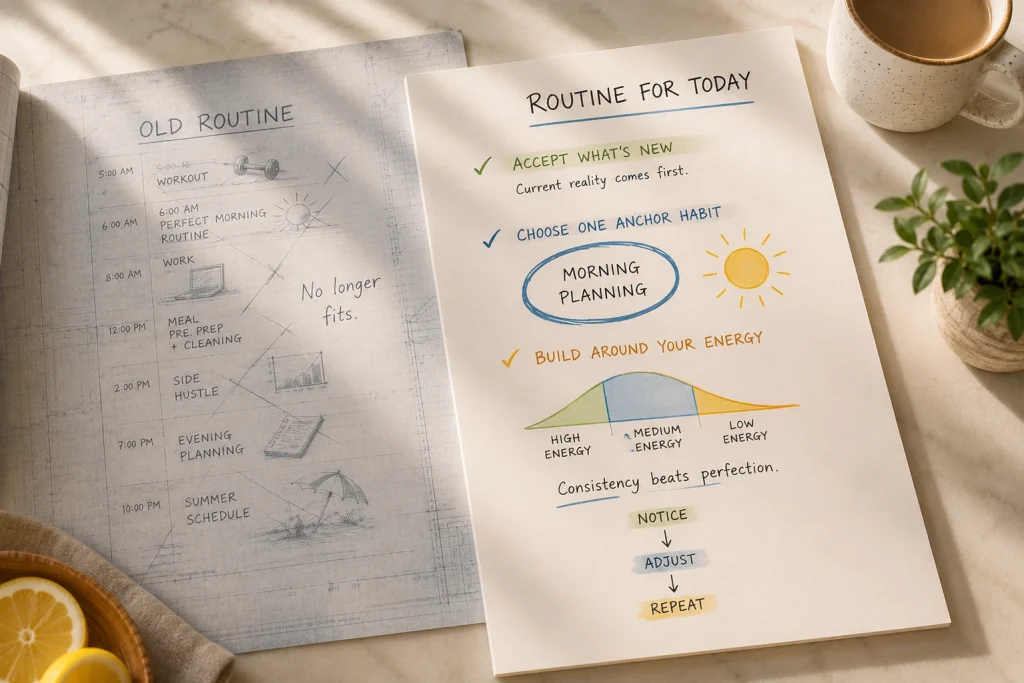
If you’re wondering how to create a routine that actually fits your life today, start with these three steps:
1. Accept what’s new and see the impact of what’s new now.
This sounds simple, but it’s often the hardest step. Many people waste energy trying to recreate a schedule that belonged to another version of themselves or another time and set of circumstances in their lives. A routine works best when it supports your current reality.
2. Start with one anchor action that you can repeat so it eventually turns into a habit.
No need to redesign your entire day. Look for one action that acts as a domino to others or simply anchors you with a good start. Examples:
- New job → Later work hours → If you used to review tomorrow’s calendar after work, move that planning habit to first thing in the morning before your day begins.
- School starts again → Mornings become rushed → Instead of packing lunches and backpacks before leaving the house, make that your last task before going to bed.
- You’re caring for a family member → Evenings become unpredictable → If your previous exercise routine no longer fits, replace it with a short lunchtime walk until life becomes more manageable.
Beginning with just one action you can repeat is fine. Introducing one new habit creates momentum for the next one.
3. Build around your current energy or timing.
One mistake I see often is planning routines around ideal circumstances. Your best bet is to build them around your actual life, with the ideal in mind but with no pressure to achieve it just yet. Some people call this starting small, taking a baby step, or breaking things down into manageable chunks.
If your mornings are hectic because school has started again, stop trying to squeeze an hour-long morning routine into thirty minutes. Find the minimum most-important actions of your morning routine and see which of those you can complete in 30 minutes.
Choosing actions you can actually repeat is absolutely required for success. When it comes to habits and behaviors, consistency beats perfection every time. Regardless of which of these routine planning strategies you choose, one thing is always true. You always need to expect adjustments when trying any routine.
People often ask me how to get into a routine as though they should be able to get it right on the first try. But that’s not how building new habits works. Think about any change you’ve ever made. Did it go perfectly the first time?
The answer for 99% of people is no.
Things go how they go on a first attempt, and what comes from that experience is learning.
If you aim to learn something that can help you refine your action or your routine, then success is just around the corner with each adjustment you make.
From here forward, think of your routine as something you refine. Notice what’s working. Notice what’s creating friction. And, without self-judgment, adjust accordingly. Adjusting things is not a sign of failure. It’s an opportunity for your learning to create a path to success.
One simple practice to get started building a routine
Here’s something I encourage many of my clients to do. Instead of writing a to-do list, write a “season list” by answering these three questions:
- What’s different about my life in the ____ (insert season)? For example: What’s different about my life in the fall?
- What habits no longer fit in the ____ (insert season)?
- What’s one action or habit that would make this season easier?
Write your answers down and keep them somewhere you’ll see them throughout the week.
This small awareness practice helps your brain accept where you are today. It creates space for new routines created one action at a time.
Keep moving forward
If there’s one idea I hope you remember, it’s this:
Habits don’t fail because you’re failing. Habits fail because the conditions they were built for have changed.
You don’t need to get back to who you were or what you were doing in any previous month of the year. You don’t need to recreate the entire routine that worked before life shifted. You need a routine that supports the person you are today and the circumstances that you live in now.
Designing a routine that supports where you are now is where lasting habit change begins.
If you’re ready to build habits that match your current season of life, the Move Strong Method® DIY program was designed to help you do exactly that. Through simple, neuroscience-based coaching practices, you’ll learn how to increase awareness, manage emotions more effectively, and make confident decisions that move you forward, one practical step at a time. Explore the DIY program and discover how small, intentional changes can help you create a routine that actually fits your life.